The dot is the best cardio in the toy box and the only prey in history that can never be caught, and both facts matter. Whether laser play is actually bad for cats, the frustration problem explained honestly, and the one session rule that keeps the dot a good guy.
Few toys split cat-owner opinion like the laser pointer: half the internet calls it the best five dollars in pet ownership, the other half calls it cruelty by frustration. The honest answer sits in the middle and comes with one rule. Laser play isn't bad for cats, and for some households it's genuinely great, but the dot has a built-in design flaw that every owner should understand before the next session: it is the only prey in history that can never, ever be caught.
The frustration problem, explained honestly
A cat's play runs on the hunt cycle: stalk, chase, catch, and the satisfying finish where the prey is secured and the sequence completes. The dot delivers a spectacular version of everything up to the catch, then physically cannot provide the ending; paws close on nothing, every time, forever. For many cats that's no big deal and the chase was the fun. But some cats come out of dot-only sessions wound tighter than they went in: pacing, searching the floor where the dot vanished, swatting at stray light reflections for days. That restless searching is the sign the hunt cycle got opened and never closed, and it's the entire legitimate criticism of laser play.
The one rule that fixes it
End every laser session on something catchable. Run the dot for the sprints, then land it on a physical toy and retire the laser while the cat "catches" the real object; a kicker is the perfect finisher because it rewards the pounce with a body to grab and bunny-kick, which is the ending the dot owed them. A tossed treat works the same way for food-driven cats: chase, pounce, crunch, cycle closed. One catchable finish converts the dot from a frustration machine into the best warm-up act in the toy box.
Session design: the rest of doing it right
Keep sessions short (five to ten minutes beats a marathon), move the dot like prey rather than a strobe (ground-level runs, pauses behind cover, no wall-ceiling chaos that teaches jumping at nothing), never shine it at eyes, and don't make the dot the only game in the rotation. If your cat is a known light-chaser who stalks reflections off watches and phones, go lighter on laser play or skip it; those cats are the ones most prone to the searching behavior, and they do better with toys that occupy paws as well as eyes.
When the laser genuinely shines
Fairness demands the other half: for mobility-limited owners, the laser is one of the few ways to run a high-energy cat to a healthy tired from a chair. For high-energy cats who need serious cardio, nothing covers ground like the dot. And on cabin-fever days, a hallway dot session is instant exercise with zero setup. All of it works, with the catchable finish attached.
The Finisher Kit

Kitty Ka-Zoom Lizard Kicker
$6.99
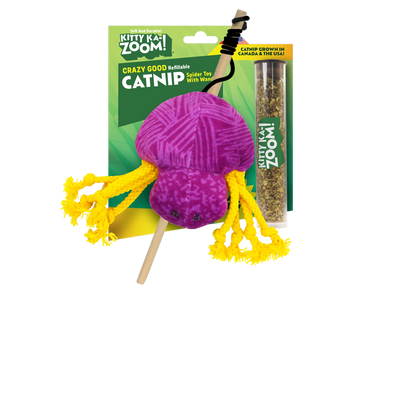
Kitty Ka-Zoom Zoomie Spider with Wand Refillable Catnip Toy
$6.99
KA-ZOOMIES CAT TREATS - Crunchy Chicken Flavor with Catnip Flavor
$4.89
The laser protocol
Three parts to doing the dot right. Click each one.
๐
The rule: end on a catchable
The dot owes them an ending
The dot can never be caught, and some cats come out of dot-only sessions wound tighter than they went in. Land the final run on a physical toy and retire the laser while they "catch" it: a kicker gives the pounce a body to grab and bunny-kick, and a tossed treat closes the cycle for food-driven cats.
๐๏ธ
Session design
Short, prey-like, never the eyes
Five to ten minutes beats a marathon. Move the dot like prey: ground-level runs, pauses behind cover, no wall-ceiling strobe chaos. Never shine it at eyes. And if your cat already stalks watch reflections and phone glare, go light on laser play; the dedicated light-chasers are the ones prone to restless searching afterward.
๐งฐ
The finisher kit
What the pounce lands on
Keep a finisher within reach before the dot comes out: the Lizard Kicker for the wrestle ending, the Zoomie Spider wand when you want the whole session catchable, and crunchy treats for the chase-pounce-crunch close. The games list has the full-cycle alternatives.
The verdict
Not bad, incomplete: the dot is half a hunt, and your job is supplying the other half. Short sessions, prey-style movement, never the eyes, and always a catchable finish, and laser play earns its spot in the rotation next to the toys that can actually lose. The games list covers the full-cycle sessions, the tire-out plan is where the dot does its best work, and the refillable lineup stocks the finishers.
Frequently Asked Questions
Are laser pointers bad for cats?
Not bad, incomplete. The dot delivers a spectacular chase but can never be caught, which leaves the hunt cycle without its ending. For many cats that's fine; some come out of dot-only sessions frustrated and searching. The fix is one rule: end every laser session on something physically catchable.
Why do cats go crazy for laser pointers?
The dot moves exactly like prey: fast, erratic, darting behind cover. It triggers the full chase instinct with none of the effort of a real toy, which is why it's the best cardio in the toy box and why the missing catch matters: the instinct it fires expects an ending.
Can laser pointers cause frustration or anxiety in cats?
In some cats, yes: the signs are pacing, searching the floor where the dot vanished, and swatting at stray reflections after sessions. Cats who already stalk light reflections are most prone. Ending sessions on a catchable toy or a tossed treat closes the hunt cycle and prevents most of it.
How do I use a laser pointer with my cat the right way?
Short sessions of five to ten minutes, dot moved like prey at ground level, never shined at eyes, and always finished on a physical catch: land the final run on a kicker toy or toss a treat, and retire the dot while the cat secures the real prize.
Are laser pointers safe for cats' eyes?
Standard pet lasers used correctly are low-powered, but never shine any laser at a cat's eyes, and aim the dot at floors and walls rather than sweeping it toward the face. The eye rule plus prey-style ground movement covers the physical-safety side; the catchable finish covers the behavioral side.
0 comments