

Every cat owner with a "lazy" cat has run the same experiment: buy a new toy, wave it around, watch the cat blink slowly and go back to sleep. After enough rounds, the conclusion writes itself: this cat just doesn't play. It's almost never true. Cats are obligate predators, and the hunting wiring doesn't uninstall itself. What actually happened is that something about the offer is wrong: the toy, the movement, the timing, or the reason to bother. All four are fixable.
Rule out the boring reasons first
The toys are always out. A toy lying in the same basket for months is furniture. Cats hunt novelty, and constant availability kills it. Just putting toys away and reintroducing them one at a time, a week apart, revives interest in half the "dead" toy boxes out there.
The catnip is stale. If your toys have catnip in them, the aroma is the engine, and it fades. Refillable toys with fresh catnip are a different product than the same toy with year-old dust in the pouch. A scent refresh is the cheapest possible fix and the most commonly skipped one.
The timing fights the cat. Cats are crepuscular: wired for dawn and dusk activity. A noon play offer lands on a sleeping animal. Move sessions to early morning or evening, ideally before meals, and the same cat often shows up entirely differently.
The prey style is wrong. Some cats are ground hunters that ignore anything airborne; some are ambushers that only commit from cover; some want to wrestle, not chase. If you've only offered one style of prey, you haven't tested the cat, you've tested one hypothesis.
Slow prey: the technique that works on couch potatoes
The biggest mistake with a low-motivation cat is moving the toy fast to "get their attention." Fast prey demands a sprint, and a couch potato has done the math on sprinting. Slow prey changes the equation.
Drag a wand toy along the ground away from your cat, slowly, with pauses. Let it creep behind a chair leg and stop. Twitch it once. The stalk is the lowest-cost move in a cat's hunting repertoire, and almost any cat will track slow, hesitant, ground-level prey with their eyes first, then their body. You're not asking for a leap; you're asking for a stare, then a creep, then one pounce. Land that pounce, let them hold the catch, and end the session. Thirty seconds of real predation beats ten minutes of ignored waving, and it builds toward more.
The blanket-edge trick deserves special mention: a toy twitching just under the edge of a blanket or rug triggers even confirmed non-players. Hidden prey that's almost visible is apparently irresistible.
The Reactivation Kit
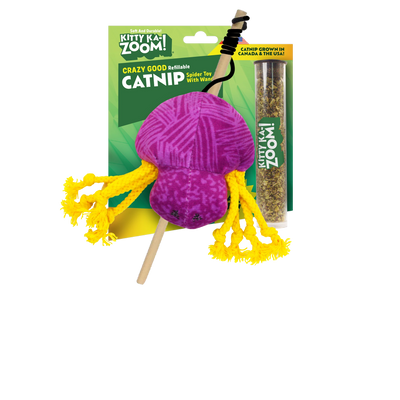
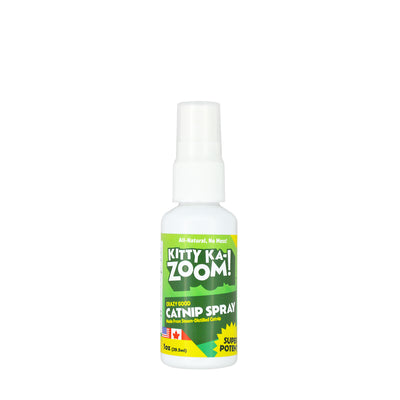
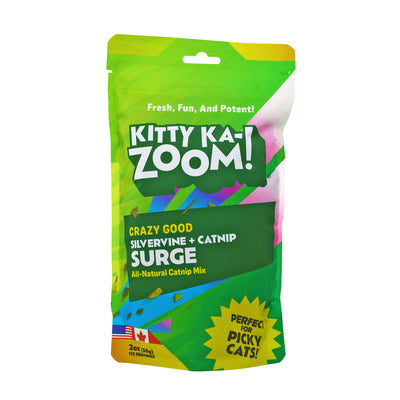
Lower the activation energy
Scent lowers the threshold for engagement the way a warm-up lowers the barrier to a workout. A spritz of catnip spray on a toy makes it worth investigating before any movement happens, and investigation is the on-ramp to play.
If catnip has never done anything for your cat, that's normal: roughly one in three cats doesn't respond, and it's genetic. Don't stop there, though. Most catnip non-responders react to silvervine, which works through different receptors. A silvervine-forward blend on or in the toy is the single most common unlock for "my cat ignores catnip toys" households.
Food is the other reliable motivator. A treat dispenser turns eating itself into batting and chasing, which gets a food-driven cat moving with zero persuasion. For real couch potatoes, it's often the first movement win, and momentum from there is real.
Build the habit in micro-sessions
Reactivating a lazy cat is a consistency game, not an intensity game. The pattern that works: short sessions, same times daily, always ending in a caught toy, ideally right before a meal so the hunt-then-eat rhythm locks in. Thirty seconds counts. Three thirty-second wins a day for two weeks will do more than one heroic twenty-minute attempt on Saturday.
Keep sessions ending on success. If your cat is losing interest, land the catch and stop rather than pushing for one more chase. Cats keep showing up for games they win. And rotate the toy weekly, even mid-streak: the refillable lineup with a fresh scent load is built for exactly this rotation.
When lazy is actually something else
The honest section: sometimes a cat that stopped playing isn't unmotivated, they're uncomfortable. Three checks worth running before you conclude anything about personality.
Weight. Extra weight makes play physically expensive, and it accumulates invisibly. Run the 30-second checks in our is-my-cat-overweight guide; if they fail, the fix starts gentler than normal play and the overweight exercise plan is the road back.
Age and joints. A senior cat that quit jumping and playing may be arthritic, which vets can actually help with. Play offers should go ground-level and gentle either way.
Sudden change. A player that stopped playing abruptly, rather than fading gradually, is a vet visit, not a training project. Behavior changes are how cats report feeling unwell.
For the ordinary couch potato, though, the diagnosis is usually the happy one: the hunter is still in there, the offers just haven't been right. Slow prey, fresh scent, better timing, and two weeks of micro-sessions will find them.


0 comments