

Most indoor cats aren't bored because they don't have enough toys. They're bored because nothing in their environment activates the full hunt sequence. You can have 20 toys on the floor and a cat that ignores all of them, because the toys are sitting still and cats don't hunt things that sit still.
Fixing indoor cat boredom isn't about adding more. It's about making what you have actually work — and setting up a consistent routine that covers every phase of what a cat naturally needs to do.
What the prey sequence actually is (and why it matters)
Cats have a hardwired prey sequence: spot, stalk, chase, catch, bite and kick, then a reward. Each phase is distinct, and each matters for a cat's mental state. A cat that never gets to finish the sequence is like someone who does the setup for a joke and never delivers the punchline — frustrated and looking for another outlet.
Most toys only cover one or two phases. A ball covers "spot and chase" but nothing after the first bat. A static plush covers "bite and kick" but nothing before it. An indoor cat needs the full sequence covered across its day, not necessarily in one toy.
The foundation: two daily interactive sessions
The single highest-impact change most cat owners can make is committing to two short, hands-on play sessions every day — morning and evening, 10-15 minutes each. Not one long weekly marathon. Two consistent short ones.
The morning session is the energy burn: fast movement, direction changes, jumps. Run the wand low to the floor, let the cat sprint and leap. The Zoomie Spider with Wand is built for this — the refillable body keeps the scent active throughout the session so the cat stays locked in.
The evening session is the wind-down: slower movement, let the cat catch the lure, end with a food reward. Cats that finish a session with a "kill" and a meal settle into sleep significantly faster than cats whose play sessions just stop.
Interactive Play Foundation

Solo toys for between sessions
Interactive sessions cover morning and evening. The rest of the day needs solo options — toys a cat can engage with independently, without you holding anything.
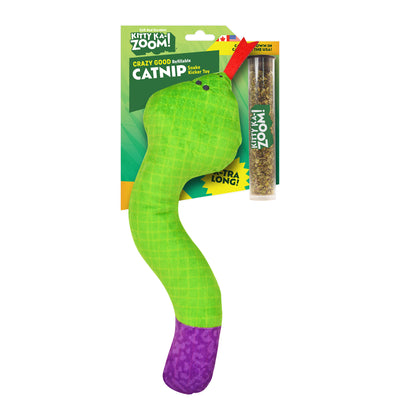
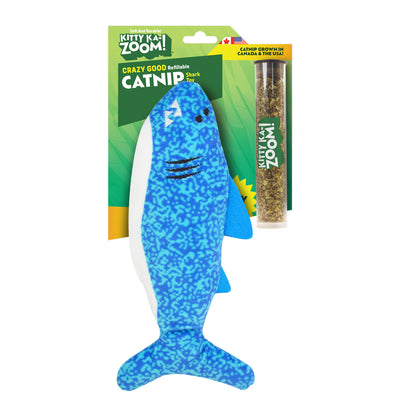
Refillable kicker toys are the best format here. The long body triggers the bunny-kick reflex (front paws grab, back legs rake), which is a complete physical engagement rather than a passive bat. With fresh catnip or silvervine blend in the pocket, a cat can work a kicker for 10-15 minutes on its own. That's the coverage you need for the hours between sessions.
Rotation matters as much as the toy itself. Cats habituate fast. Leave the same kicker in the same spot every day and it stops registering as interesting. Rotate two or three toys so something is always a little bit novel.
Refillable Solo Play


Adding mental stimulation (the thing most people skip)
Physical play gets most of the attention, but mental stimulation is often what bridges the gap for cats that still seem restless after good play sessions. Cats that are physically tired but mentally under-stimulated don't settle the same way.
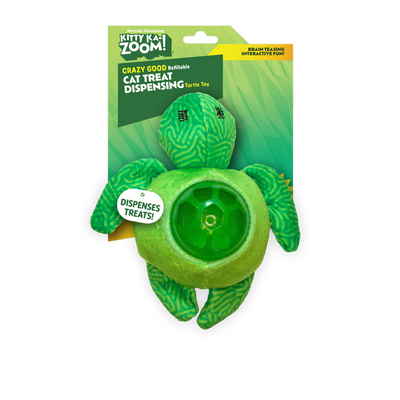
Puzzle feeders are the most accessible entry point. The Zoomie Sea Turtle is a rolling treat dispenser — load it with Ka-Zoomies treats, set the opening easy at first, and let your cat figure out how to extract the reward. A 15-minute session with a puzzle toy often produces more genuine calm than the same time spent with a wand.
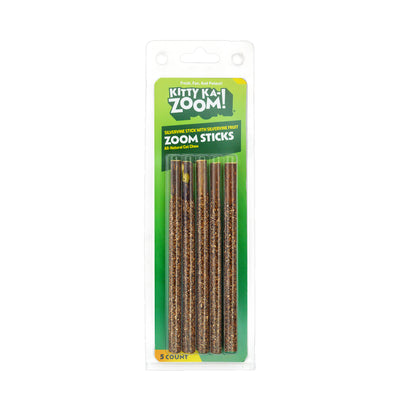
The other option is scent enrichment. Cats process scent information the way humans process reading — it requires active cognitive engagement. Hiding a scent toy or a silvervine stick in a new spot and letting your cat locate it covers both mental work and a phase of the prey sequence (the stalk).
Mental Stimulation


Environmental enrichment that costs nothing
Toys and play are part of the picture. The environment matters too. A cat with window access — something to watch, bird feeders to monitor, movement outside — is less bored between play sessions than a cat staring at a blank wall. Vertical space (cat trees, shelves, a cleared-off bookcase) gives a cat somewhere to survey from and somewhere to climb to, both of which are natural behaviors that don't require toys.
Neither replaces play, but both reduce the baseline boredom level so you're not fighting an uphill battle every session.
Signs the routine is working
A cat whose needs are met tends to: sleep in long stretches after play, have a predictable energy spike in the morning and evening (not at 3am), not fixate on your feet or ankles, and settle willingly in its favorite spots between activity periods.
A cat whose needs aren't met tends to: vocalize randomly, stalk and redirect aggression toward you or other pets, bat things off shelves without play intent, and have irregular sleep patterns. Those are behavioral signals, not personality quirks — they're the cat communicating that something in its day isn't being covered.
Fix the routine before looking at other causes. Most of the time, two consistent daily sessions plus good solo toy coverage is enough.


0 comments